Unit turns
Turn time is the only maintenance metric that lands in NOI.
Every other number is a labor line. A vacant day is rent you will never collect, and the make-ready is the part you control.
Ayla cut make-ready time 51% across 340 units.
The board
A whiteboard cannot tell you which unit is behind.
It also cannot tell you which tech is overloaded, or document a repair for an insurance claim.
Every stage timestamped
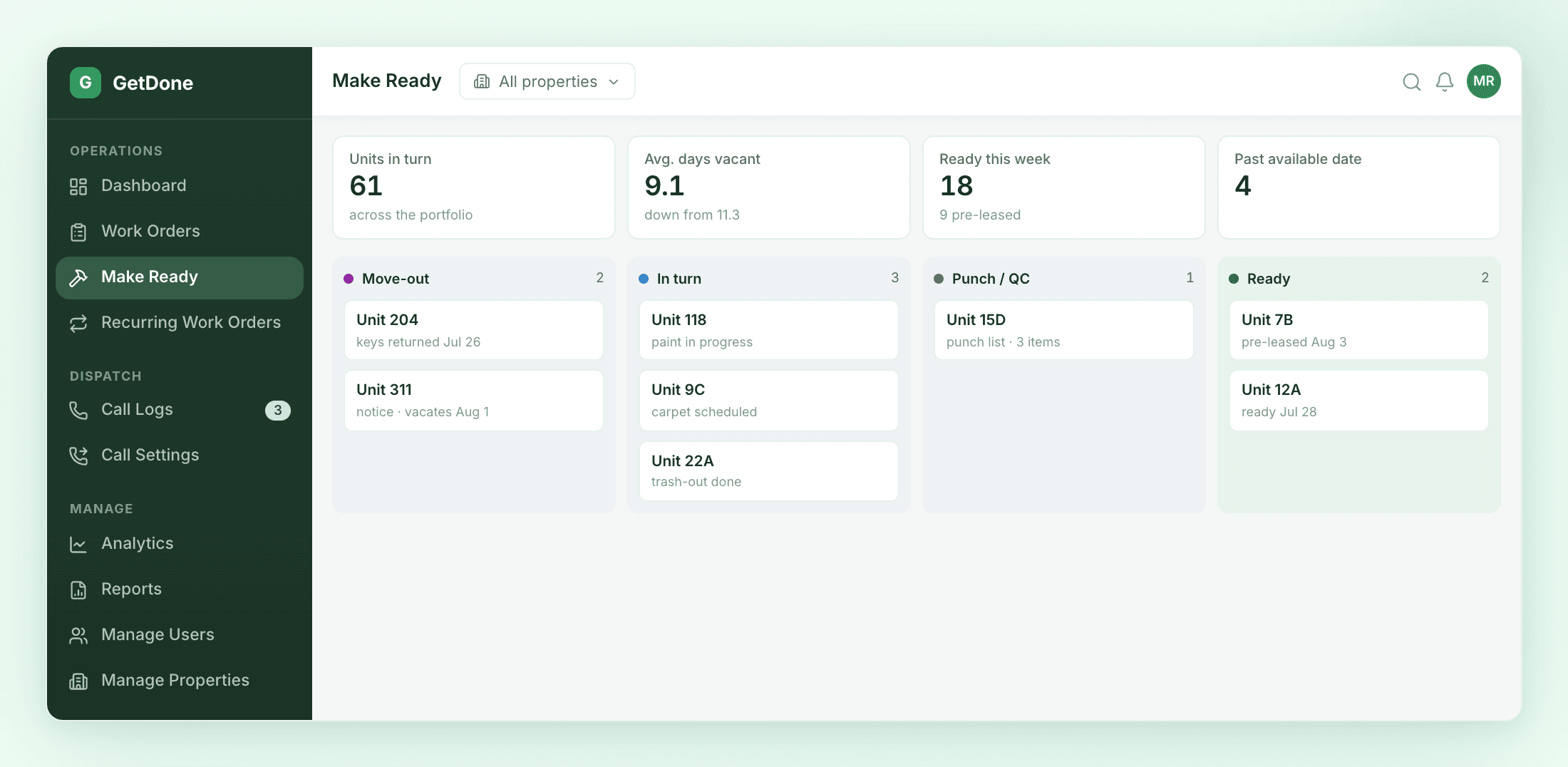
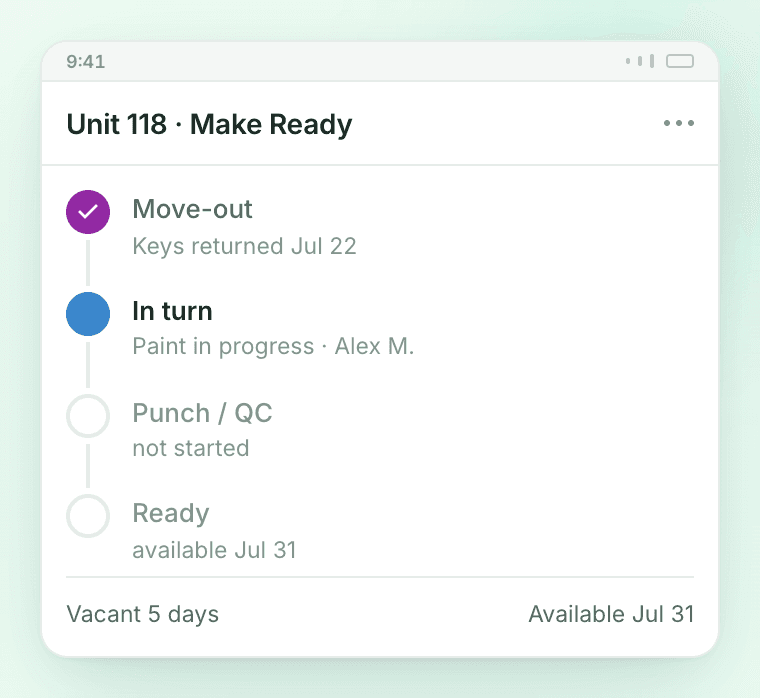
Move-out, scope, paint, carpet, punch, clean, inspect, ready. Without stage timestamps you know a turn took 11 days and nothing about where it went.
One board, every unit
List, board, or grid view of every unit in turn, with a progress bar per unit. Replaces the whiteboard only the supervisor can read.
Handoffs that do not drop
Paint finishing notifies carpet. The schedule stops living in one person's head, which is what breaks when that person takes a week off.
Days vacant, per unit
Units in turn, average days vacant, units ready this week, units past their available date. The four numbers a regional actually asks for.
Ayla Apartments
$601,807 of vacancy loss in a single year.
A 340-unit Class C community in Tampa, built in 1966. Techs traveled between work orders by golf cart, then drove back to the leasing office to pick up the next one. Paper from start to finish.
At least an hour of labor lost per tech per day, to travel alone
Work orders collected from a desk rather than pushed to a phone
Slow turns meant vacant units sat longer
51% reduction in average make-ready time after GetDone
55% reduction in vacancy loss, same property, year over year
Run it on your own portfolio
At $1,500 a month, a vacant day costs $50. Two days off an average turn is $100 back, per turn.
Multiply by the turns you actually did last year. Not by a per-100-units figure, because your turnover rate is the variable that makes those extrapolations wrong.
Sort properties by average turn descending and look at the top five. That is where the recoverable money is concentrated, and it is never spread evenly.
What actually slows a turn
Three of the four causes are information problems.
Which is why working harder does not fix it.
The handoff. Paint finishes and nobody tells carpet, so the unit sits two days between trades.
Materials. The tech arrives, the part is wrong, and the unit waits on a delivery nobody tracked.
Scope discovery. A cursory move-out inspection means real damage surfaces on day four and resets the schedule.
Travel. On a spread-out campus this is not trivial. Ayla lost an hour a day per tech to it.
FAQ
Turn time questions
What counts as the start of a turn?
Will techs actually use it?
Does this replace our PMS?
What if our make-ready scope varies by property?
How fast does turn time actually move?
Bring us your five slowest turns.
We will show you which stage they are sitting in, and what the make-ready board does with them.