Portfolio systems, PMS, and buying
The hidden cost of strategy debt
Human variance creates strategy debt. What 40 to 50 percent turnover does to a January plan, and how we moved 24,000 units to a new interface in 19 days.
Let's say you run a 20,000-unit property management company that offers third-party management services to conventional multi-family properties. You staff maintenance technicians, property managers, leasing consultants, as well as your centralized corporate employees.
It's the beginning of budget season, and you've decided that this is the year where innovation will happen. You may have decided to roll out valet trash, improve maintenance efficiencies, or implement a new piece of software.
Then comes the inevitable, or even more often today, the status quo: high employee turnover.
Staff leave properties and positions, and new staff come in to fill them. Each staff member brings their own capabilities, skills, and experience. But that also means each staff member brings their own uniqueness, and uniqueness = variance.
This turnover continues until any resemblance to your original strategy is buried in a closet.
Human variance is the least understood and most reactionary variable in any service business today, including property management. As you increase the number of units under management, you inevitably need more staff to run them. With more staff, the hidden cost of human variance keeps compounding and adds more and more complexity along the way.
What is human variance?
For the sake of this blog, human variance is defined as the difference between person A, person B, person n, etc., in terms of output.
- Human variance is the gap between poor performance and good performance.
- Human variance is the gap between poor resident experience and good resident experience.
- Human variance is the gap between poor outcomes and good outcomes.
The key theme here is that humans operate on a spectrum, but we often forget that. But what does this have to do with "strategy debt" or property management?
Strategy debt is the compounding of missed opportunities
Every property management group has a dark closet in the office stacked with "strategies that were never delivered" or "things that were never achieved". Year after year, we kick off budgeting season with good intentions and bright ideas. We'll plan to roll out valet trash, we'll increase our occupancy from 93% to 95%, or we'll reduce on-site turnover below 40%.
In software engineering, engineers use the term "technical debt" to describe the compounding effects of things that never get done. Take a shortcut when writing code now, and you'll surely pay interest later when that comes back to bite you. This debt exists across property management, too. We defer implementing software to improve our accounting practices, then get to the end of the year and realize we're missing invoices due to human variance. Strategy debt builds when we are okay with living on the left side of human variance. When we avoid things that might seem hard or difficult (but often necessary), we build debt.
For property management companies battling high turnover, often between 40 and 50 percent a year, human variance is compounded by changes in staff. At that rate, an idea or strategy that came up in January disappears when 40 to 50 percent of a property's staff are new at a property. Or, even worse, you find a way to keep that strategy alive, but an entirely new staff inherits a half-built process or confusion around ownership.
Why human variance hurts execution
As we established, property management is a business of human variance. A resident calls late on a Friday because the AC failed and there's a newborn in the unit. A leasing agent gives notice the week before a lease-up. Neither situation was planned for, and every hour spent dealing with human variance is an hour lost that could have been allocated to executing budget strategies.
This is exactly how an organization ends up operating in a catch-up mode. All of these strategies sit in the closet because the business as a whole spends years absorbing human variance.
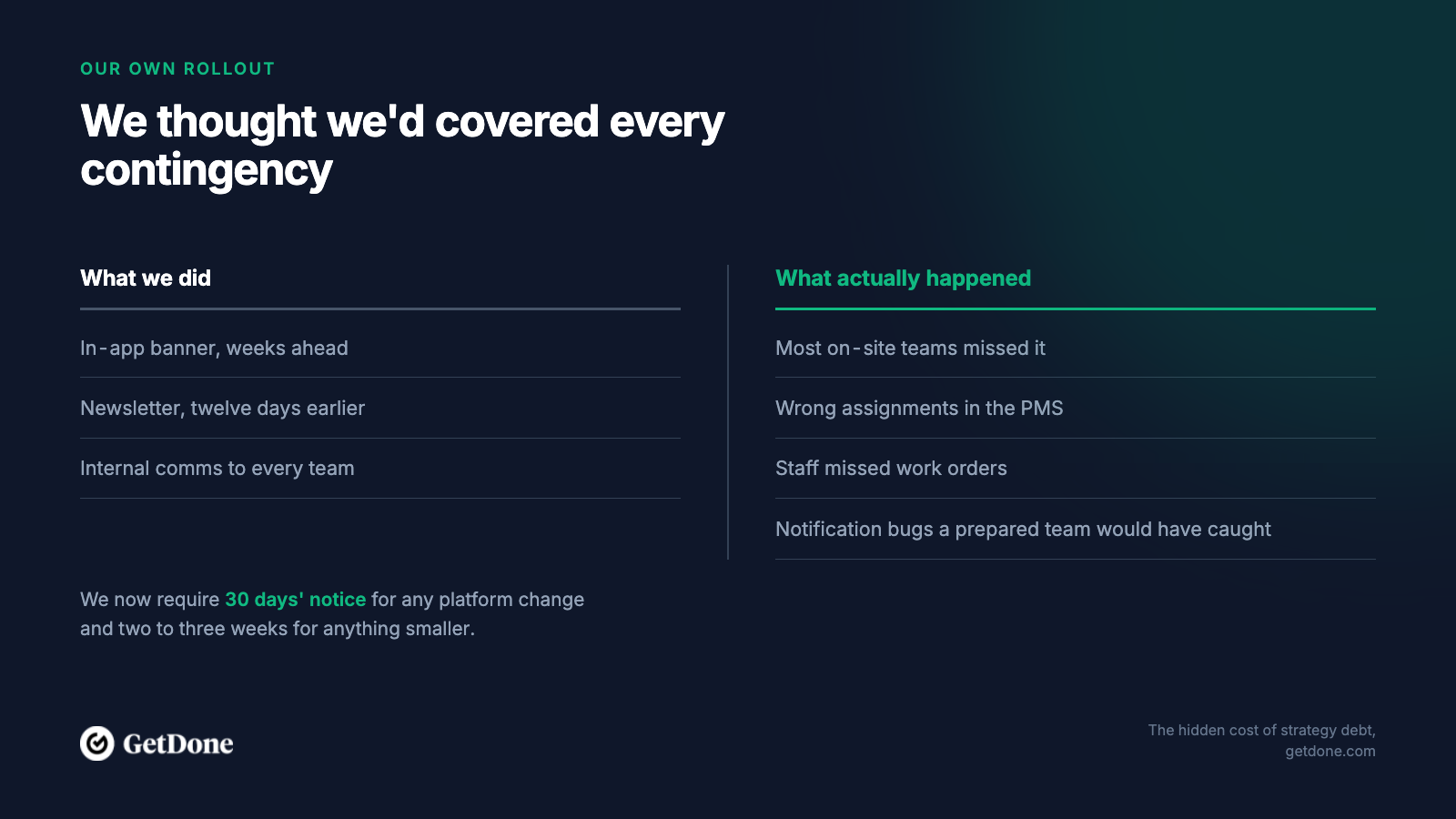
We still see this in our own property management business. We recently rolled out a completely new design and feature set to our in-house maintenance solution, GetDone. We planned extensively for this roll-out and thought we'd covered every contingency.
We launched an in-app banner telling site teams it was coming, which went up weeks prior to go-live. A newsletter had mentioned it twelve days earlier as "coming soon." We communicated extensively internally to ensure teams were notified prior to these changes.
What actually happened? Most on-site teams missed the communications and were impacted by an unexpected early-morning change to their maintenance system. The first few days of this rollout caused wrong assignments in the PMS, staff to miss work orders, and notification bugs that a prepared team would have caught in training. We now require 30 days' notice for any platform change and two to three weeks for anything smaller. This change will account for a wide spectrum of human variance but will also create strategy debt.
Everyone walks up to the same wall and stops
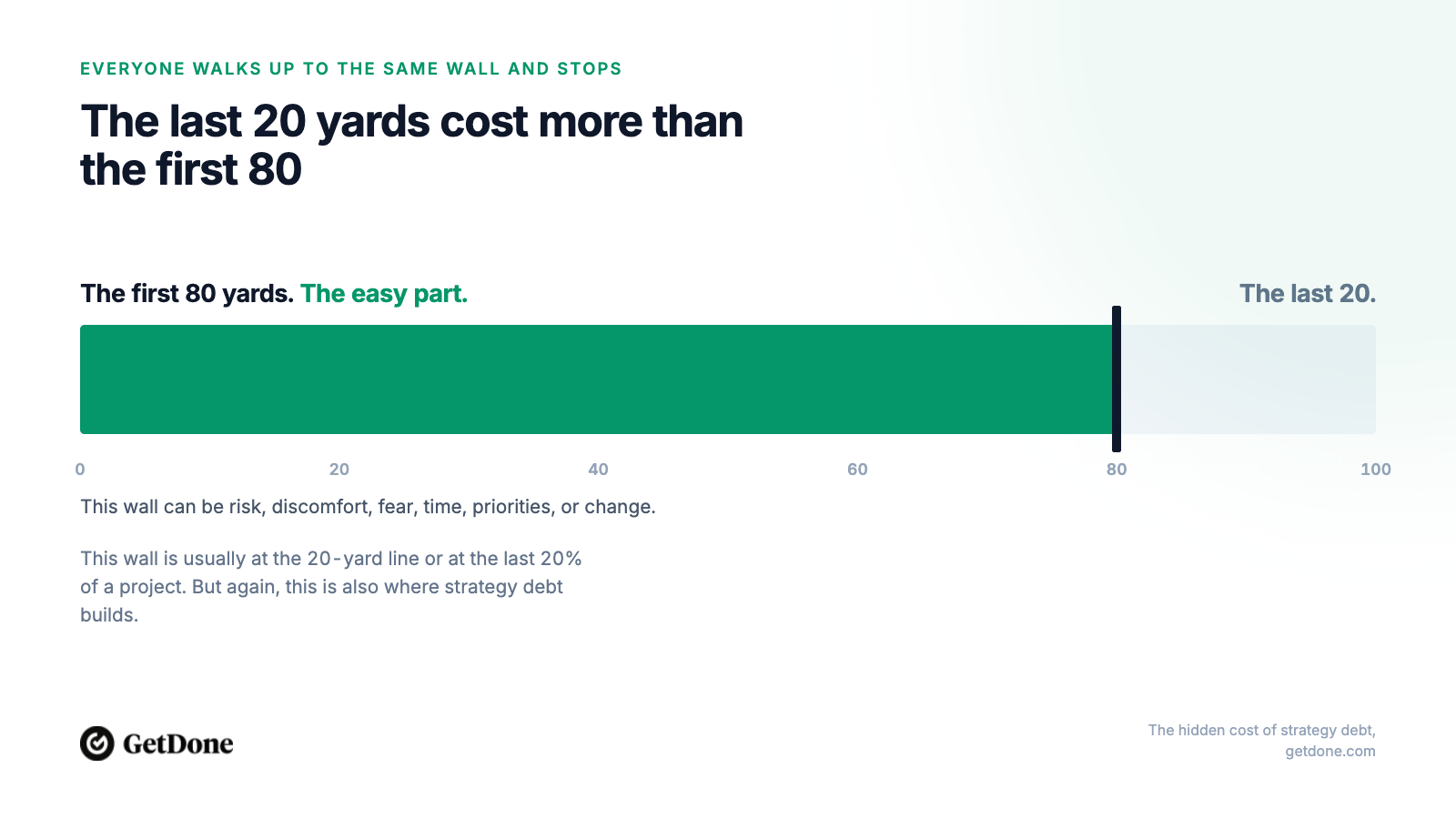
There's a line in every organization, an invisible vertical wall, where people walk up to it and stop. This wall can be risk, discomfort, fear, time, priorities, or change. This wall is usually at the 20-yard line or at the last 20% of a project. But again, this is also where strategy debt builds.
Organizations that build a culture where this wall is as close to the goal line as possible have little strategy debt. These organizations usually have a culture of high ownership and high initiative. These are also the organizations that embrace change.
Ownership, initiative, and change show up as new systems, new software, and new processes. These organizations actively push back against "we're okay with how things have always been". They implement new software even when it may add work in the short term. They actively push for new processes even if it means staying late to put together new training plans.
But human variance says that not everyone will show up with these skills and traits on day one. Human variance means some staff will likely be okay with inferior processes and won't take initiative.
Then, strategy debt starts stacking.
The last 20 yards cost more than the first 80
Property managers should focus on building both processes to encourage closing out the 20% as well as implementing software that reduces the impact of human variance.
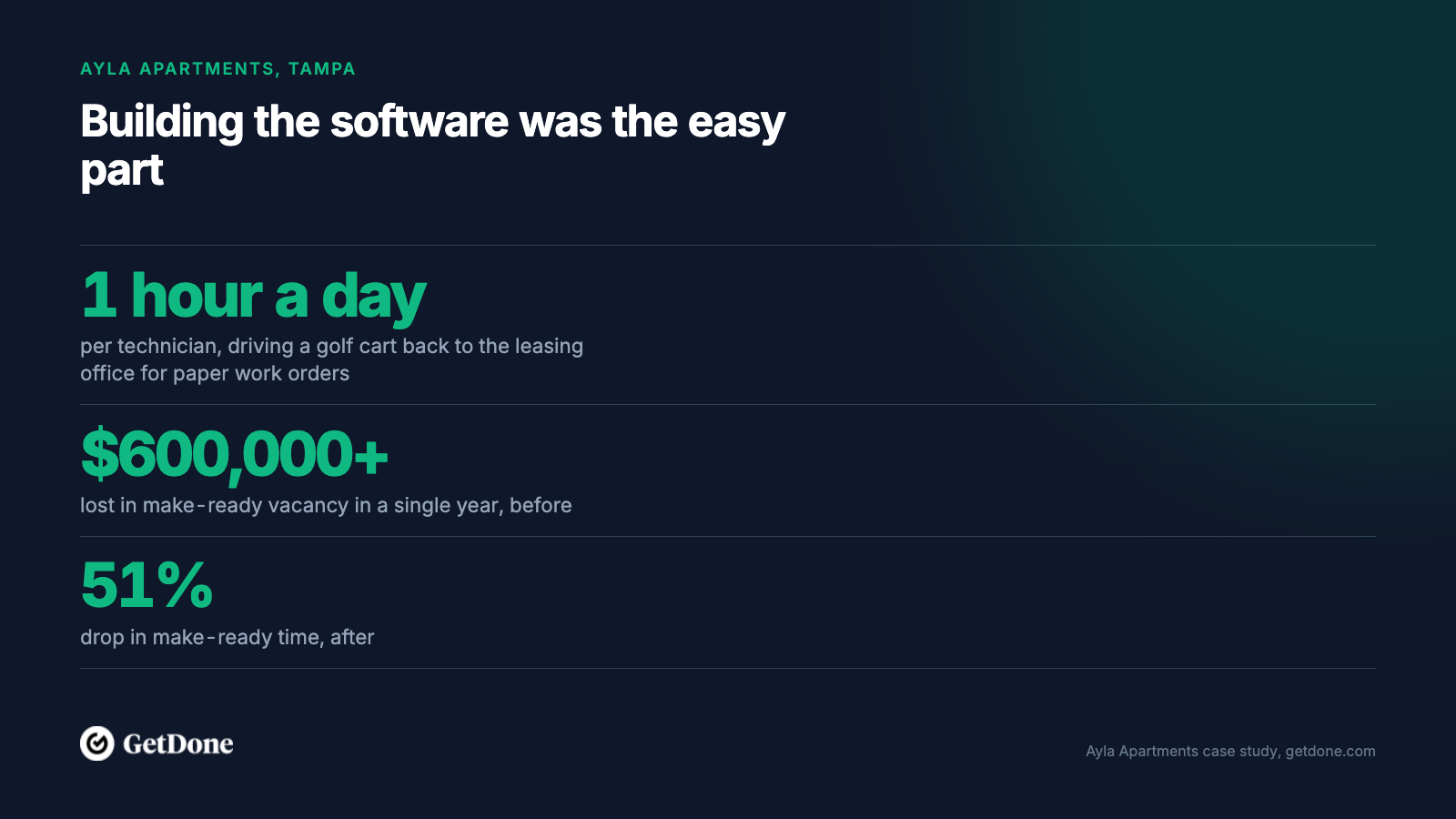
Our maintenance solution, GetDone, sits across our entire portfolio of 24,000 units in Texas, Florida, and the Carolinas. At Ayla Apartments in Tampa, technicians burned an hour a day driving a golf cart back to the leasing office for paperwork orders, and the property lost over $600,000 in make-ready vacancy in a single year. Building the software was the first 80 yards and was the easy part. The last 20 was getting every technician working from the phone instead of the whiteboard or printed paper work orders. Ayla's make-ready time fell 51 percent. Across the portfolio, 94 percent of assigned technicians log work in the system each period. Our lowest property sits at 46 percent.
As painful as the initial rollout was, and with each new major update, this software has significantly reduced human variance. Software handles most of the execution that would normally fall to a human. Newer AI features now empower on-site teams to be more productive and reduce the breadth of human variance. A human is always in the loop, but the outcome of their actions is standardized and measurable.
Solving for human variance and reducing strategy debt
Now, you're probably asking, "What's the answer here?"
First, let's recap the problem: human variance creates strategy debt.
Second, let's remember the definition of human variance: the difference between person A, person B, person n, etc., in terms of output.
So, to avoid the cycle of strategies with a brief shelf life that inevitably get moved to a dark closet and die, remove human variance as much as possible. Don't let human variance be the "norm"; fight it by setting clear, direct expectations. Even better, raise the bar on ownership and initiative within the company, and don't back down. This is how great cultures are established.
Second, implement systems and software to remove variance from your operations. Relying on humans to solve problems without a system of record, especially during high-turnover situations, is a recipe for disaster. In operations with no centralized warehouse of information, new staff are constantly at a disadvantage and unlikely to implement strategies they don't know about or don't have the details for.
Let's say you have a new Regional Maintenance Director filling a vacancy. If there is no maintenance software, or the software is poorly implemented, this individual will spend countless hours sifting through printed work orders, having one-on-one conversations with staff, and performing manual audits. This leaves significant room for human variance to creep in, which means the output of that work is left to chance.
Instead, if maintenance software is implemented across the portfolio, highly leveraged, and operationalized, this Regional Maintenance Director can easily find answers to their questions. They will be able to see the performance of individual maintenance technicians, how long they take to complete certain tasks, and see how long it takes to turn around units. All of this data is immutable, factual, and accurate. Even better, if the software provides extensive analytics, recommendations, or leverages AI to further guide this Regional Maintenance Director's decisions, you're further removing human variance.
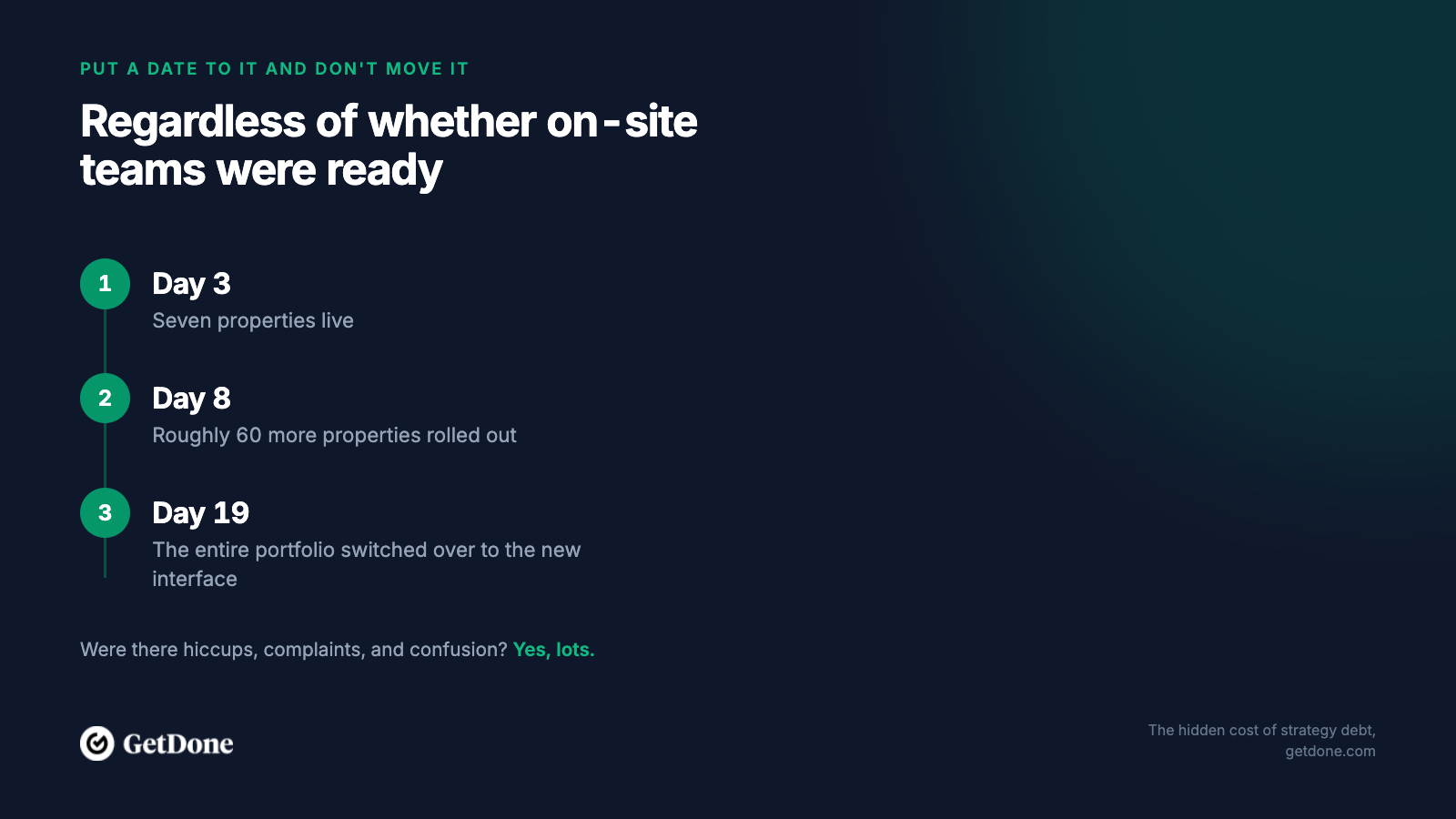
Lastly, on the operational side, once a strategy is formalized, put a date to it and don't move it. With our cutover to the new GetDone design and interface, we set a date for the change, regardless of whether on-site teams were ready. This might sound counterintuitive or even dismissive to those teams, but necessary to move beyond that invisible wall. On day 3, we had seven properties live. On day 8, we had rolled out roughly 60 more properties. By day 19, we had switched the entire portfolio over to this new interface.
Were there hiccups, complaints, and confusion? Yes, lots.
But is the business better off now than it would be if we didn't set a firm deadline, implement a great piece of technology, and ultimately deliver a better resident experience? Yes.
Like most organizations, we would have stopped at 80%, sat on a lack of ownership, and inevitably this implementation might have ended up in the closet. Then human variance would start to widen, opening the business up to more and more strategy debt.
Embrace change, embrace challenge, and don't let human variance determine success or failure.
Keep reading
Team performance, pay, and retention
Why maintenance techs quit
Pay is the reason given at the exit interview. The reasons underneath are usually a whiteboard, a radio, and a supervisor buried in paperwork at the end of every shift.
Portfolio systems, PMS, and buying
How to compare multifamily maintenance software
Every product in this category has work orders, a mobile app, and analytics. Nine questions separate them, and they work on us too.
Team performance, pay, and retention
Maintenance technician KPIs: nine metrics worth tracking
Completion count is the metric everyone starts with and the one that teaches the wrong behavior. Callback rate is the honest one, and it is usually not measured at all.